
This chapter should be cited as follows:
Cárcamo W, Fescina R, et al., Glob Libr Women's Med
ISSN: 1756-2228; DOI 10.3843/GLOWM.416463
The Continuous Textbook of Women’s Medicine Series – Obstetrics Module
Volume 20
Surgical Techniques in Obstetrics
Volume Editors:
Professor Michael Stark, New European Surgical Academy (NESA) and Charité University Hospital, Berlin, Germany
Professor Sergej Barinov, Omsk State Medical University, Ministry of Health of Russia
Professor Gian Carlo Di Renzo, PREIS International School, Florence, Italy
Chapter
Special Considerations Related to Cesarean Delivery in Low- and Middle-Income Countries
First published: February 2022
Updated: October 2026
Study Assessment Option
By answering four multiple-choice questions (randomly selected) after studying this chapter, readers can qualify for Continuing Professional Development points plus a Study Completion Certificate from GLOWM.
See end of chapter for details.

INTRODUCTION
The aim of cesarean delivery is to offer an alternative route to birth, preventing damage and preserving the life of mother and child. This initially saving intervention has in recent years become a public health challenge due to the large increase in its incidence, in many cases without justification.
The advancement of anesthetic, surgical and antibiotic techniques has greatly reduced morbidity and mortality, resulting in a substantial increase in the use of cesarean delivery in recent decades, with rates exceeding 50% in some countries. However, in poorer countries such as those in sub-Saharan Africa, the frequency of cesarean delivery is below that which is medically indicated, paradoxically failing to meet population needs in settings in which conditions such as obstructed labor are more common and may require cesarean delivery.
In 1985, following an expert meeting convened by the World Health Organization (WHO), a population cesarean delivery rate of 10–15% was proposed as an upper limit.1 However, subsequent evidence suggested that maternal and neonatal mortality decreased with increasing cesarean delivery rates up to approximately 19%, with no further reduction in mortality at higher rates. In contrast, countries with cesarean delivery rates below 10%, had higher maternal and neonatal mortality.2
Unfortunately, cesarean delivery without medical indication has increased to an unacceptable level, leading to an increased risk of maternal morbidity, including infection and, in subsequent pregnancy, uterine rupture and placenta accreta spectrum, as well as increased risk of mortality compared to vaginal delivery. In addition, cesarean delivery results in an increased risk for neonatal complications, including a greater number of resuscitation maneuvers, more respiratory complications and delayed early breastfeeding.3
Not only is cesarean delivery associated with increased maternal and neonatal morbidity, but it also incurs higher healthcare costs due to longer hospital stays and higher rates of hospital readmission.
The above concerns translate into a significant worldwide public health problem, both for countries with overutilization of cesarean delivery (above the 19% rate) and those with underutilization of cesarean delivery (rates around 5%) due to lack of access to appropriate health services with qualified personnel.
Consequently, solutions to decreasing or increasing cesarean delivery rates should be derived according to a detailed analysis of the population studied, with an understanding that the approach should be tailored to each country or group of countries with similar epidemiological situations, access to health services and availability of trained professionals.
EPIDEMIOLOGY
Birth rates vary from country to country and the route of birth is greatly influenced by cultural traditions and access to healthcare.4,5,6,7,8 Over the past 50 years, due to significant improvement in healthcare systems, an increasing number of newborns have been delivered in medically controlled settings, such as hospitals and small clinics. While these factors have contributed to a reduction in perinatal morbidity and mortality worldwide, some reports indicate that they have also led to unjustified overuse of procedures such as cesarean section,9 and consequently increased healthcare costs.10,11
Cesarean delivery constitutes a life-saving surgery for women and babies when complications occur, such as labor hemorrhage, fetal distress, abnormal fetal presentation and hypertensive disease, and has become the most common surgical intervention in many countries. In recent years, the ideal cesarean delivery rate has been debated in the context of increasing use, concerns about quality of care and patient safety, and marked variation between countries. Rates have ranged from approximately 1–2% in some African countries to more than 50% in several countries, including the Dominican Republic, Brazil and Egypt.12,13
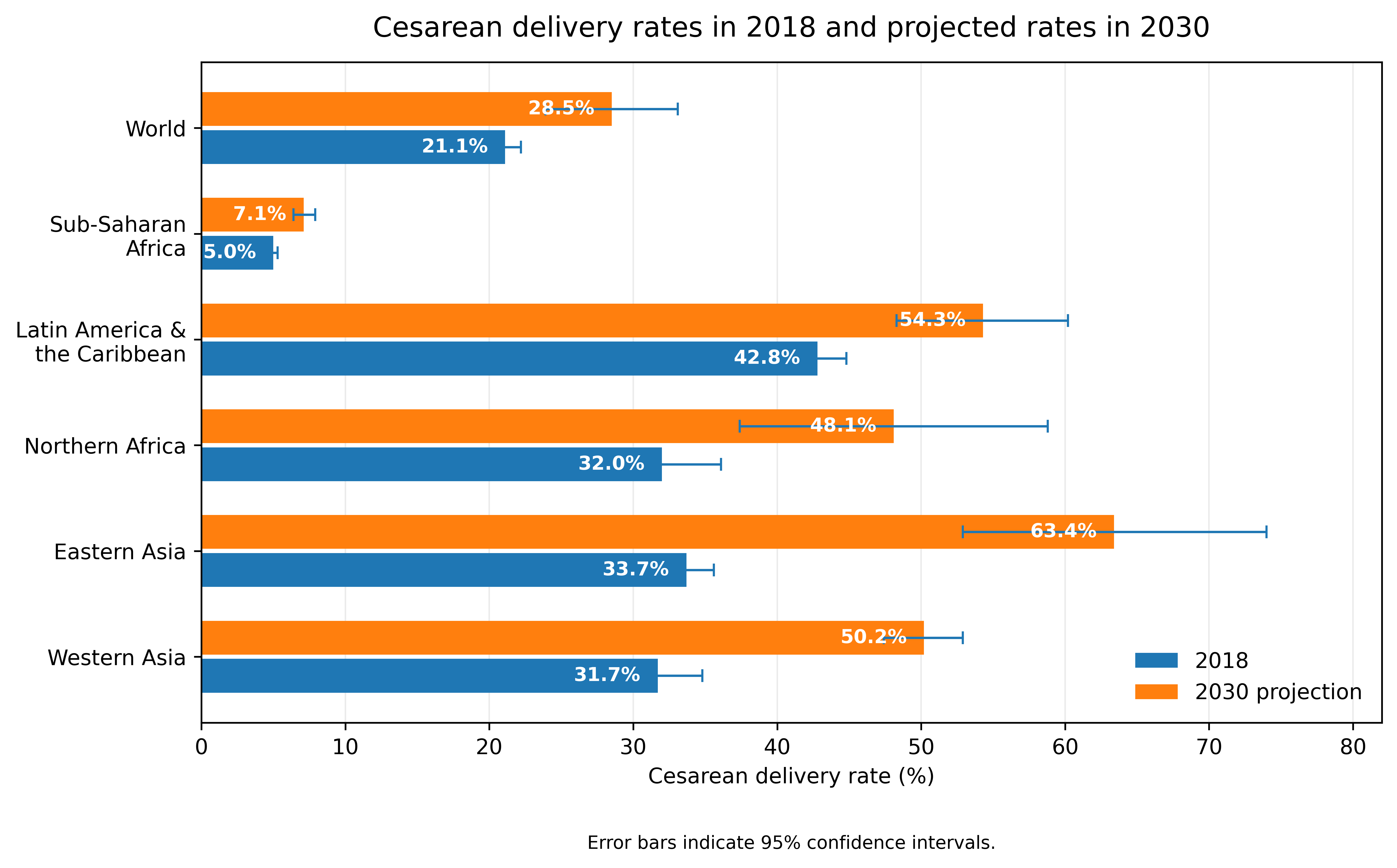
In 2018, an estimated 21.1% of births worldwide were by cesarean delivery, with rates ranging from 5.0% in sub-Saharan Africa to 42.8% in Latin America and the Caribbean. Projections suggest that, if current trends continue, 28.5% of births worldwide will be by cesarean delivery by 2030, with rates reaching 63.4% in Eastern Asia (Figure 1).14
Boerma and colleagues, in their 2018 publication,15 reported that the global annual average increase in cesarean delivery was 3.7% between 2000 to 2015. During this period, the rate of cesarean delivery varied greatly between the nine regions of the world: 4.1% (3.6–4.6%) in West and Central Africa to 44.3% (41.3–47.4%) in Latin America and the Caribbean, this being the region with the highest rate.
1
Cesarean delivery rates in 2018 and projected rates in 2030 in the world and selected regions and subregions. Error bars indicate 95% confidence intervals. The 2018 estimates are based on the latest available nationally representative data from 2010–2018. The 2030 rates are model-based projections assuming continuation of previous trends. Adapted from Betran AP, Ye J, Moller A-B, et al. Trends and projections of caesarean section rates: global and regional estimates. BMJ Glob Health 2021;6:e005671. doi:10.1136/bmjgh-2021-005671.14
Increases in the rate of cesarean delivery were observed in all world regions, occurring more rapidly in Eastern Europe, Central Asia, South Asia, East Asia and Pacific regions, with average annual rates of change exceeding 5%, compared with 2.1% in West and Central Africa and 2.0% in Eastern and Southern Africa.15
Although cesarean rates above 20% appear to be associated with more harm than benefit, rates exceeding 50% have been reported.2,16,17 In 1985, WHO convened a group of experts who concluded, based on the evidence available at the time, that 'there is no justification for any region to have a cesarean section rate higher than 10–15%'.1,18 In 2015, Molina et al. found that maternal and neonatal mortality was lowest at cesarean delivery rates around 19%, suggesting that the rate previously cited by WHO may be lower than the level associated with the lowest mortality.2
In the struggle for better quality and safety in healthcare, the cesarean delivery rate has been selected as one of the indicators for monitoring quality of care.19,20 Low-income countries (LICs), especially in sub-Saharan Africa, have historically had very low cesarean delivery rates, probably reflecting inadequate availability, while high-income countries (HICs) generally have higher cesarean delivery rates, which may indicate overuse. Very high rates have also been reported in several middle-income countries (MICs), including Brazil, the Dominican Republic and Egypt.15
MATERNAL AND PERINATAL REPERCUSSIONS
As with any other surgery, cesarean delivery is associated with short- and long-term risks that can last for many years after surgery and affect the health of the mother and the newborn, as well as the outcome of future pregnancies. These risks are greatest in women with little access to comprehensive obstetric care.
Observational studies have reported an increased risk of maternal mortality following cesarean delivery, although the extent to which this reflects the underlying indications and medical conditions leading to cesarean delivery is difficult to determine.21,22
A population-based retrospective cohort study using the Canadian Perinatal Surveillance System found that the frequency of severe maternal morbidity was three times higher among women undergoing planned cesarean delivery than among those with planned vaginal delivery (27.3 and 9.0 per 1000 deliveries, respectively).23 Severe maternal morbidity included hemorrhage requiring hysterectomy or transfusion, uterine rupture, anesthetic complications, cardiac arrest, shock, acute renal failure, assisted ventilation, amniotic fluid embolism, venous thromboembolism, severe postpartum infection, wound dehiscence, and surgical wound hematoma. The difference in in-hospital maternal mortality between the groups was not statistically significant.23
Compared with newborns born by vaginal delivery, those born by elective cesarean delivery at term (from 37 weeks’ gestation) have an increased risk of respiratory morbidity, with the risk increasing as gestational age decreases. Elective cesarean delivery before 39 weeks’ gestation is therefore not recommended because of the increased risk of neonatal respiratory morbidity compared with delivery at or after 39 weeks.24
The risks associated with delivery at 37–38 weeks are greater than the theoretical benefits when the medical or obstetric indication allows delivery to be deferred, such as in cases of suspected fetal macrosomia in women without diabetes or history of a non-recurrent maternal or fetal complication in a previous pregnancy. Delivery is recommended at 39 weeks rather than performing a fetal pulmonary maturity test at 37–38 weeks to justify early delivery.
In the long term, babies delivered by cesarean section compared to those born vaginally are at increased risk of developing allergic upper respiratory tract disorders such as allergic rhinitis, asthma (more common in girls), celiac disease, diabetes mellitus and gastroenteritis.25,26
Mothers delivering by cesarean section can experience late complications such as uterine isthmocele, a defect in the myometrial wall secondary to the cesarean delivery scar, which can manifest clinically by abnormal or postmenstrual bleeding, chronic pelvic pain, infertility or, in cases of future pregnancy, abnormal placentation, scar dehiscence, uterine rupture or ectopic pregnancy localized in the cesarean section scar.27,28
CAUSES AND SOLUTIONS ACCORDING TO SCENARIO
In general, there is an excess of cesarean deliveries in many countries in Europe and the Americas, highlighting the need for efforts to reduce unnecessary procedures. In contrast, countries such as Haiti and those in sub-Saharan Africa have very low cesarean delivery rates, often below 5%. This represents one of the paradoxes of cesarean delivery: the countries with the lowest rates often have the highest concentrations of populations at risk of obstetric complications that may require cesarean delivery.29 Where rates substantially exceed 20%, measures to reduce unnecessary cesarean deliveries may be warranted; conversely, where rates are below 10%, efforts should focus on ensuring timely access to safe cesarean delivery when medically indicated, to reduce maternal and neonatal complications.
Settings with high prevalence
The reasons for high cesarean delivery rates are not always well established, but in many cases may reflect the practices of healthcare professionals as well as maternal request. The main categories of indications for cesarean delivery (maternal, fetal, uterine or a combination of these) have increased substantially over the past few decades. In general, uterine indications have changed little, whereas some maternal and fetal indications have more than tripled compared with previous decades.
Non-reassuring fetal status
Cesarean delivery for non-reassuring fetal status has increased more than three fold in the last decades without logical explanation, in particular when the cesarean delivery results in the birth of a vigorous baby with normal Apgar scores. This implies an over-diagnosis of non-reassuring fetal status often due to misinterpretation of electronic fetal monitoring tracings or confusion in interpretation of auscultation of early, late and variable decelerations prompting quick intervention by cesarean.
Breech presentation
Breech presentation has become a standard indication for cesarean delivery since Hannah's work demonstrated less fetal-neonatal morbidity when delivered by cesarean at term gestation.30 By extrapolation, this approach has been extended to preterm breech presentation, contributing to an increase in cesarean delivery, although the incidence of breech presentation is considerably higher at lower gestational ages, reaching approximately 30% compared with 3–4% at term.30,31 This approach has also been extended to multiple pregnancies, although the evidence and recommendations vary according to the presentation of the first fetus and gestational age.
Failed induction
Failed induction as an indication for cesarean delivery has increased greatly, and may result from elective induction of labor. A retrospective study in Uruguay noted an increase in inductions at term (39–40 weeks) with low Bishop scores and without specific indications for the induction, which was associated with a threefold increase in the risk of cesarean delivery, particularly among nulliparous women.32 The decision to offer elective induction at term should take into account its potential risks and benefits. This differs from induction for postdates pregnancy, particularly when pregnancy reaches 42 weeks, when induction is generally recommended rather than continued monitoring of fetal-maternal wellbeing.
Contrasting the experience in South America, a collaborative randomized multicenter study in the USA of induction of labor in nulliparous low-risk women at 39 weeks, showed a reduction in cesarean delivery in the induced group compared with the group of women managed expectantly: 18.6% vs 22.2% (RR 0.84; 95% CI, 0.76–0.93). Both groups had similar neonatal results.33 This conflicting information may in part be due to the different socioeconomic conditions between countries, medical attitudes and population sampling. The Uruguayan study was retrospective, but it involved the vast majority of deliveries in the country. The USA study was a randomized controlled clinical trial, which is generally considered to provide a higher level of evidence.
Fear-of-malpractice litigation
Another factor that has contributed to the increasing rate of cesarean delivery is fear of malpractice litigation. This concern is partly driven by the perception that failure to perform a cesarean delivery may result in adverse neonatal neurological outcomes. However, as early as 1995, there was evidence that cesarean delivery was not associated with a reduction in neonatal neurological problems.34
Socioeconomic and demographic factors
Socioeconomic and demographic factors represent a variety of elements that lead to an increase in cesarean delivery. It was shown as long as 20 years ago that there is a direct and significant correlation between patient’s family income and indication for cesarean delivery, i.e. the higher income, the greater the chance of cesarean delivery,35 a correlation also seen in patients with private insurance vs those using public hospitals.
The almost universal use of cesarean delivery has been documented in women with a high economic status in private health facilities such as in Brazil.36 It is important to bear in mind, in this group of Brazilian patients, the mother's preference for cesarean delivery. While the mother's right to request cesarean delivery is indisputable, after discussion of the benefits and risks, if she still opts for elective cesarean delivery in the absence of a medical indication, the medical record should clearly document maternal request as the indication for surgery, rather than using other medical indications to justify the procedure. This is important if reducing reimbursement for elective cesarean delivery performed on maternal request is part of a strategy to reduce cesarean delivery rates. This would require a significant public education campaign.
Other factors responsible for the increase in cesarean delivery include decreased parity, women getting pregnant at a later age and obesity.
History of prior cesarean section
Without a doubt the most important factor that explains more than 30% of all cesarean deliveries, is a history of prior cesarean section. For this reason, it is important to establish the reason for the primary section because it will determine the obstetric future of the gestant.
A trial of labor should generally be offered to women with a history of a low transverse cesarean incision, as the traditional notion that 'once a cesarean, always a cesarean' is no longer considered valid in obstetric practice. The risk of uterine rupture during a trial of labor is low (less than 1%) and the likelihood of successful vaginal birth is high, particularly when the previous cesarean was performed for a non-recurrent obstetric indication.
In 2011, the Pan American Health Organization (PAHO) included among the indicators for monitoring its Action Plan to Accelerate the Reduction of Maternal Mortality and Severe Maternal Morbidity a target for countries with cesarean delivery rates above 20% to reduce their rates by at least 20% by 2017. However, among the 18 countries that reported their cesarean delivery rates, rates remained stable or increased slightly during implementation of the plan.37
In high-prevalence settings, the following measures should be considered to reduce cesarean delivery rates: development and implementation of standardized protocols for indications for cesarean delivery; training of healthcare professionals in the management of normal labor and in offering a trial of labor after cesarean delivery; interventions to reduce pain; and avoidance of primary cesarean by adopting contemporary definitions of the stages of labor, including not limiting the latent phase and defining the active phase from 6 cm of cervical dilation. A diagnosis of lack of progress in cervical dilation should require at least 4 h of observation. The use of a partogram to monitor labor progress can be helpful not only for monitoring labor but also for teaching appropriate approaches to labor management.
It is also necessary to improve the physical infrastructure of obstetric triage and delivery rooms to increase mothers' privacy and comfort and to ensure that they can be accompanied during labor by someone of their choice, including a doula, which has been shown to be an effective intervention for reducing cesarean delivery (RR 0.75, 95% CI 0.64–0.88).38 Antenatal classes providing preparation for labor and delivery should also be offered.
Financial incentives should be considered for professionals and institutions that support and provide vaginal delivery. Management of normal labor may require several hours of surveillance, averaging 8–10 hours depending on parity, while cesarean delivery can usually be performed in approximately 1 hour. Payment for vaginal delivery should therefore be appropriately aligned with the time and resources required, to avoid financial incentives that may favor cesarean delivery. Similarly, institutions with lower cesarean delivery rates could be rewarded for effective management of labor and appropriate use of cesarean delivery.
Institutions should be regularly monitored by reviewing cesarean delivery rates and indications as measures of quality and safety, with outcomes compared to those of other institutions. This benchmarking is particularly important, although it is often avoided by institutions.
Settings with low prevalence
In regions with low cesarean delivery rates (<10%), measures should be implemented, in addition to the interventions discussed above, to ensure universal access to healthcare services, particularly for vulnerable populations lacking access to obstetric care and skilled birth attendants. Health facilities should have adequate infrastructure to support safe childbirth, including the capacity to perform cesarean delivery, access to anesthesia, effective infection prevention and control, and safe blood transfusion services.
Insufficient numbers of qualified personnel, inadequate training of providers and/or absence of evidence-based care guidelines constitute significant problems, even when some health infrastructure is available. Geographical, social (including migrant or refugee status) and economic barriers can prevent women from accessing available care, resulting in large health disparities within countries, with maternal morbidity and mortality often concentrated among the most vulnerable populations.
In parts of sub-Saharan Africa, limited access to health services and trained personnel results in many women giving birth at home without adequate conditions for safe childbirth. The circumstances of childbirth vary considerably: giving birth in a setting without reliable access to clean water, electricity and other basic facilities is very different from giving birth in a well-equipped facility with access to comprehensive obstetric care and rapid transfer to a hospital when needed. These disparities contribute to the serious consequences of prolonged obstructed labor, including stillbirth and severe maternal morbidity. Obstetric-trauma-related vesicovaginal fistulas, which are rare in developed countries, remain an important problem in sub-Saharan Africa. Because surgical intervention is often required for repair, women may need to travel considerable distances to access specialist care, adding to the financial burden for women and their families.. These human and financial burdens will persist unless access to quality obstetric care and skilled personnel trained in the monitoring and management of childbirth is improved.39
It should be noted that obstructed labor remains an important cause of maternal morbidity and mortality in settings with limited access to skilled obstetric care, whereas it has become a rare cause of death and severe maternal morbidity in countries with high rates of institutional births.
Many interventions have been proposed to address the lack of access to appropriate cesarean delivery when needed, including training non-physician healthcare personnel to perform cesarean sections and administer anesthesia.40 Such approaches require rigorous evaluation before widespread implementation. These measures should be considered only as an intermediate step towards achieving an optimal level of care, ensuring that all women, regardless of socioeconomic status, have access to safe maternal and neonatal care.
PRACTICE RECOMMENDATIONS
- Assess cesarean delivery rates in the context of local needs and resources. Strategies should distinguish between settings in which cesarean delivery is overused and those in which women lack timely access to medically indicated cesarean delivery.
- In settings with high cesarean delivery rates, develop and implement standardized, evidence-based protocols for indications for cesarean delivery. Particular attention should be given to the diagnosis of non-reassuring fetal status, labor dystocia or lack of progress, failed induction and breech presentation.
- Support appropriate management of normal labor. Healthcare professionals should be trained in contemporary definitions of the latent and active phases of labor, avoiding premature diagnosis of labor arrest and allowing adequate time for cervical dilation before diagnosing lack of progress.
- Avoid unnecessary primary cesarean delivery. Indications should be carefully assessed, and interventions that may increase the likelihood of cesarean delivery, including unnecessary induction of labor, should be avoided.
- Offer an appropriate trial of labor after previous cesarean delivery. Women with a previous low-transverse cesarean delivery should generally be offered the option of trial of labor when clinically appropriate, with appropriate counseling and facilities for safe management.
- Provide women with adequate information and support during labor. Interventions should include effective pain relief, antenatal preparation for labor, privacy and comfort, and the opportunity for continuous support from a person of the woman's choice, including a doula where available.
- Ensure that financial and institutional incentives do not favor cesarean delivery over vaginal delivery. Payment systems should appropriately reflect the time and resources required for safe management of normal labor, and institutions should monitor and benchmark cesarean delivery rates and indications.
- In settings with low cesarean delivery rates, improve timely access to safe cesarean delivery when medically indicated. This requires adequate infrastructure, trained healthcare professionals, anesthesia services, infection prevention and control, blood transfusion services, and access to comprehensive obstetric care, particularly for vulnerable and geographically remote populations.
CONFLICTS OF INTEREST
The author(s) of this chapter declare that they have no interests that conflict with the contents of the chapter.
Feedback
Publishers’ note: We are constantly trying to update and enhance chapters in this Series. So if you have any constructive comments about this chapter please provide them to us by selecting the "Your Feedback" link in the left-hand column.
REFERENCES
Appropriate technology for birth. Lancet 1985;2(8452):436–7. | |
Molina G, Weiser TG, Lipsitz SR, et al. Relationship Between Cesarean Delivery Rate and Maternal and Neonatal Mortality. JAMA 2015;314(21):2263–70. | |
American College of Obstetricians and Gynecologists. Obstetric care consensus no. 1: Safe prevention of the primary cesarean delivery. Obstetrics and Gynecology 2014;123(3):693–711. | |
Sandelowski M, Bustamante R. Cesarean birth outside the natural childbirth culture. Res Nurs Health 1986;9(2):81–8. | |
Chong ESY, Mongelli M. Attitudes of Singapore women toward cesarean and vaginal deliveries. Int J Gynecol Obstet 2003;80(2):189–94. | |
Fawcett J, Pollio N, Tully A. Women's perceptions of cesarean and vaginal delivery: another look. Res Nurs Health 1992;15(6):439–46. | |
McCourt C, Weaver J, Statham H, et al. Elective cesarean section and decision making: a critical review of the literature. Birth 2007;34(1):65–79. | |
Hou L, Li G, Zou L, et al. Cesarean delivery rate and indications in mainland China a cross sectional study in 2011. Zhonghua Fu Chan Ke Za Zhi 2014;49(10):728–35. | |
Mozes B, Schiff E, Modan B. Factors affecting inappropriate hospital stay. Int J Qual Health Care 1991;3(3):211–17. | |
McMichael AJ, McKee M, Shkolnikov V, et al. Mortality trends and setbacks: global convergence or divergence? The Lancet 2004;363(9415):1155–59. | |
Hsiao WC. The Chinese health care system: lessons for other nations. Soc Sci Med 1995;41(8):1047–55. | |
Biccard BM, Madiba TE, Kluyts HL, et al. African Surgical Outcomes Study (ASOS) investigators. Perioperative patient outcomes in the African Surgical Outcomes Study: a 7-day prospective observational cohort study. Lancet 2018;391(10130):1589–98. | |
Betran AP, Ye J, Moller AB, et al. The increasing trend in Caesarean section rates: global, regional and national estimates: 1990–2014. PLoS One 2016;11(2):e0148343. | |
Betran AP, Ye J, Moller AB, Souza JP, Zhang J. Trends and projections of caesarean section rates: global and regional estimates. BMJ Glob Health. 2021 Jun;6(6):e005671. doi: 10.1136/bmjgh-2021-005671. | |
Boerma T, Ronsmans C, Melesse DY, et al. Global epidemiology of use of and disparities in caesarean sections. Lancet 2018;392(10155):1341–8. | |
Nakamura-Pereira M, Leal MC, Esteves-Pereira AP, et al. "Use of Robson classification to assess cesarean section rate in Brazil: the role of source of payment for childbirth. Play Health 2016;13(Suppl 3):128. | |
Althabe F, Belizán JM. Caesarean section: the paradox. Lancet 2006;368(9546):1472–3. | |
Betran AP, Torloni MR, Zhang JJ, Golmezoglu AM; WHO Working Group on Caesarean Section. WHO Statement on Caesarean Section Rates. BJOG 2016;123(5):667–70. | |
Norum J, Heyd A, Hjelseth B, et al. Quality of obstetric care in the sparsely populated sub-arctic area of Norway 2009–2011. BMC Pregnancy and Childbirth 2013;13:175. | |
Norwegian Directorate of Health, Quality of Care Indicators, Norwegian Directorate of Health, Oslo, Norway, 2017. | |
Deneux-Tharaux C, Carmona E, Bouvier Colle MH. Postpartum Maternal Mortality and Cesarean Delivery. Obstet & Gynecol 2006;108(3 Pt 1):541–8. | |
Kallianidis AF, Schutte JM, van Roosmalen J, van den Akker T; Maternal Mortality and Severe Morbidity Audit Committee of the Netherlands Society of Obstetrics and Gynecology. Maternal mortality after cesarean section in the Netherlands. Eur J Obstet Gynecol Reprod Biol. 2018 Oct;229:148-152. doi: 10.1016/j.ejogrb.2018.08.586. | |
Liu S, Liston RM, Joseph KS, et al.; Maternal Health Study Group of the Canadian Perinatal Surveillance System. Maternal mortality and severe morbidity associated with low-risk planned cesarean delivery versus planned vaginal delivery at term. CMAJ 2007;176(4):455–60. | |
Villar J, Carroli G, Zavaleta N, et al.; World Health Organization 2005 Global Survey on Maternal and Perinatal Health Research Group. Maternal and neonatal individual risks and benefits associated with caesarean delivery: multicentre prospective study. BMJ 2007;335(7628):1025. | |
Neu J, Rushing J. Cesarean versus vaginal delivery: long-term infant outcomes and the hygiene hypothesis. Clin Perinatol 2011;38(2):321–31. | |
Benedetti FO, Agudelo RC, Rodríguez RR, et al. Prevalence of isthmuscele at the Hospital de San José in Bogota, Colombia. Revi ChiL Obstet Gynecomol 2016;81(6):465–72. | |
Society for Maternal-Fetal Medicine (SMFM). Electronic address: pubs@smfm.org, Miller R, Timor-Tritsch IE, Gyamfi-Bannerman C. Society for Maternal-Fetal Medicine (SMFM) Consult Series #49: Cesarean scar pregnancy. Am J Obstet Gynecol 2020;222(5):B2–14. | |
Renz-Polster H, David MR, Buist AS, et al. Caesarean section delivery and the risk of allergic disorders in childhood. Clin Exp Allergy 2005;35(11):1466–72. | |
Betran AP, Merialdi M, Lauer JA, et al. Rates of caesarean section: analysis of global, regional and national estimates. Paediatr Perinat Epidemiologol 2007;21(2):98–113. | |
Hannah ME, Hannah WJ, Hewson SA, et al., for the Term Breech Trial Collaborative Group. Planned caesarean section versus planned vaginal birth for breech presentation at term: a randomised multicentre trial. Lancet 2000;356(9239):1375–83. | |
Thomas J, Paranjothy S. Clinical Effectiveness Support Unit. The National Sentinel Caesarean section Audit Report. RCOG 2001. | |
Sosa C, De Mucio B. Contribution of labor induction in the increasing of c-section rates. Ten years of experiences in a LAC country. Preliminary results. Published in PAHO/CLAP/Webinar “The way of being born and its impact in the short, médium and long term” November 18th 2020. Available in: https://www.paho.org/sites/default/files/ops_presentation_sosa.pdf). | |
Grobman WA, Rice MM, Reddy UM, et al.; Eunice Kennedy Shriver National Institute of Child Health and Human Development Maternal–Fetal Medicine Units Network. Labor Induction versus Expectant Management in Low-Risk Nulliparous Women. N Engl J Med 2018;379(6):513–23. | |
Lien JM, Towers CV, Quilligan EJ, et al. Term early-onset neonatal seizure: Obstetric characteristics, etiology classifications, and perinatal care. Obstet Gynecol 1995;85(2):163–9. | |
Fescina R, A incidência da Cesárea nas Américas. Jornal da Federacion Brasileira de Obstetricia y Ginecologia 2000;7(1). | |
Barros AJ, Santos IS, Matijasevich A, et al. Patterns of deliveries in a Brazilian birth cohort: almost universal cesarean sections for the better-off. Rev Saude Publica 2011;45:635–43. | |
56° Consejo Directivo 70.a Sesión del comité regional de la OMS para las américas. Washington, DC, EUA, del 23 al 27 de septiembre del 2018. Punto 8.14 del orden del día provisional. Plan de acción para acelerar la reducción de la mortalidad materna y la morbilidad materna grave: informe final. CD56/INF/14. 2 de julio del 2018. | |
Bohren MA, Hofmeyr GJ, Sakala C, et al. Continuous support for women during childbirth. Cochrane Database of Syst Rev 2017;7. Art. No.: CD003766. | |
Wall LL. Obstetric vesicovaginal fistula as an international public-health problem. Lancet 2006;368:1201. | |
Zakhari A, Konci R, Nguyen DB, Amar-Zifkin A, Smith JP, Mansour FW, Krishnamurthy S. Task shifting cesarean sections in low- and middle-income countries: A systematic review and meta-analysis. Int J Gynaecol Obstet. 2023 Mar;160(3):771-782. doi: 10.1002/ijgo.14401. |
Online Study Assessment Option
All readers who are qualified doctors or allied medical professionals can automatically receive 2 Continuing Professional Development points plus a Study Completion Certificate from GLOWM for successfully answering four multiple-choice questions (randomly selected) based on the study of this chapter. Medical students can receive the Study Completion Certificate only.
(To find out more about the Continuing Professional Development awards program CLICK HERE)
