
This chapter should be cited as follows:
Fazari ABE, Abdalla M, et al., Glob Libr Women's Med
ISSN: 1756-2228; DOI 10.3843/GLOWM.415823
The Continuous Textbook of Women’s Medicine Series – Gynecology Module
Volume 1
Female genital mutilation
Volume Editor:
Professor Anne-Beatrice Kihara, University of Nairobi, Kenya,
President-elect. The International Federation of Gynecology and Obestetrics FIGO
President, African Federation of Obstetricians and Gynecologists (AFOG)
Chapter
Clinical and Surgical Management of Women and Girls Who Have Undergone Female Genital Mutilation
First published: October 2022
Updated: August 2026
Study Assessment Option
By answering four multiple-choice questions (randomly selected) after studying this chapter, readers can qualify for Continuing Professional Development points plus a Study Completion Certificate from GLOWM.
See end of chapter for details.

INTRODUCTION
Female genital mutilation (FGM), sometimes referred to as female circumcision (FC), describes practices that manipulate, alter or remove the external genitalia in girls and women for non-medical reasons.1 Although practiced around the world, it is particularly common in Africa and the Middle East. UNICEF estimates that more than 230 million girls and women alive today have undergone FGM, concentrated mainly in 31 countries across Africa, the Middle East and Asia, though the practice has been documented in as many as 94 countries when smaller and diaspora communities are considered.2 Outside Africa, FGM is practiced in Yemen, Iraq, Kurdistan and parts of Indonesia and Malaysia. Far smaller numbers have been recorded in India, Pakistan, Sri Lanka, the United Arab Emirates, Oman, Peru and Colombia.
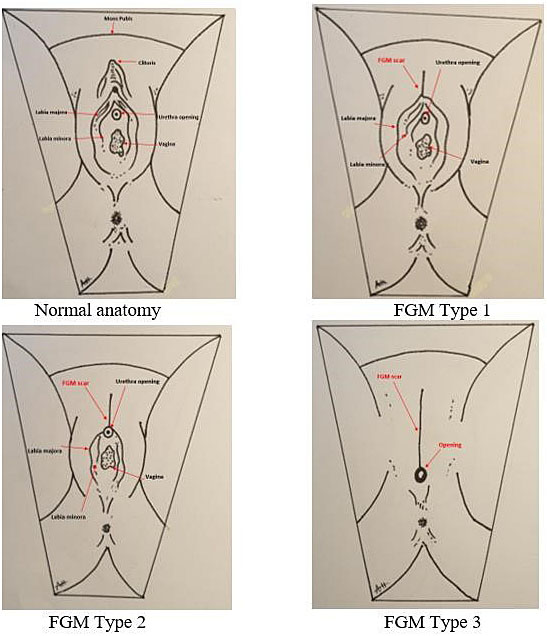
The World Health Organization (WHO) classifies female genital mutilation into four major types (Figure 1): Type I, removal of the prepuce and/or clitoris; Type II, removal of clitoris and labia minora; Type III, also known as infibulation, the vaginal opening is altered to create a smaller orifice, with or without the removal of the external genitalia; and Type IV, includes all other harmful procedures to the female genitalia for non-medical purposes, including pricking, pulling, piercing, scraping and cauterization.3
1
World Health Organization's classification of female genital mutilation.3
Type | Description |
Type I | Partial or total removal of the clitoris and/or the prepuce (clitoridectomy). |
Type II | Partial or total removal of the clitoris and the labia minora, with or without excision of the labia majora (excision). |
Type III | Narrowing of the vaginal orifice with creation of a covering seal by cutting and appositioning the labia minora and/or the labia majora, with or without excision of the clitoris (infibulation). |
Type IV | All other harmful procedures to the female genitalia for non-medical purposes, for example, pricking, piercing, incising, scraping and cauterization. |
1
Diagrammatic representation of normal anatomy and different FGM types.
2
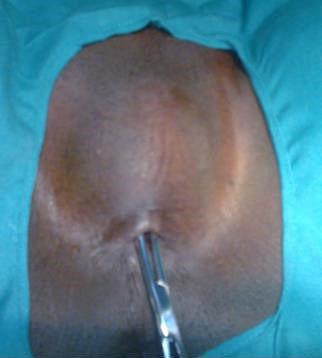
Typical FGM type 3 (infibulation), the most severe form of FGM.
Classification of FGM types may sometimes be difficult because of the following factors:
- Lack of anatomical knowledge of the female genitalia.
- The procedure is often performed at an age when the genitalia are not fully developed and are smaller in size.
- The procedures are generally not performed according to standard surgical techniques.
- Lack of anesthetics.
- Psychological fear and stress from the use of physical force for the procedure.
- Post-FGM sequelae, including infection and changes resulting from the healing process.
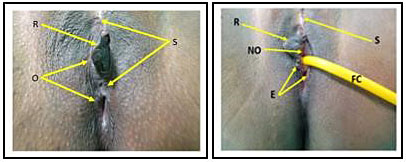
FGM may present with considerable anatomical variability, reflecting differences in both the extent of tissue excision and the techniques employed during the procedure. For example, the clitoris and labia minora may remain anatomically intact but become concealed beneath the excised and subsequently approximated labia majora following infibulation. Excision may also be asymmetric, with tissue removed predominantly from one side and the residual tissue sutured toward the contralateral side. In other instances, remnants of the labia majora may be approximated to an otherwise intact labium minus. Such anatomical variations can pose challenges in accurately classifying the original FGM type, particularly following complete healing, tissue remodeling or subsequent deinfibulation. Nevertheless, characteristic scar configurations, together with careful assessment of the residual anatomical structures, may provide important clues regarding the original extent and type of FGM, as illustrated in Figures 3 and 4.
3
Atypical anatomical appearances following FGM and deinfibulation. The left image shows two scars (S) and two openings (O), with remnants of vulvar tissue (R) seen between them. The right image shows a single opening (NO), with remnants of predominantly the right labium minus (R), and a visible urethral meatus with a Foley catheter (FC) in situ. The margin of the opening (E) is healthy. The patient consented to deinfibulation only and declined further surgery, thus the original high scar remains visible.
4
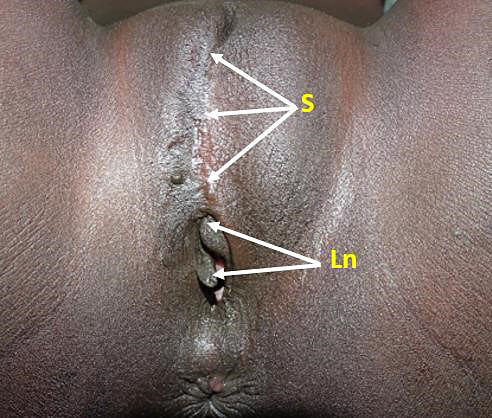
FGM Type III (infibulation). The image shows extensive scar and keloid formation (S), with residual portions of the labia minora (Ln).
FGM is most commonly performed during infancy or childhood and generally before the age of 15, although it may occasionally be performed in adulthood.3 It is often performed by traditional practitioners with little or no medical training. The procedure may be performed without anesthesia and using instruments such as blades or other cutting implements. In some settings, however, FGM is performed in healthcare facilities or by healthcare providers, a practice known as medicalization.
FGM can have serious immediate and long-term health consequences, including severe pain, hemorrhage, infection, urinary problems, impaired wound healing, abnormal scarring, psychological problems including post-traumatic stress disorder, and complications during childbirth. FGM is also associated with an increased risk of adverse neonatal outcome.4
FGM usually has deep-rooted sociocultural origins in the communities in which it is practised. In some settings, it functions as a social norm, and families may face considerable pressure to conform to community expectations. Although no major religious text prescribes FGM, the practice is sometimes associated with religious beliefs or perceived religious requirements. Other commonly cited reasons include cultural ideals of modesty, femininity and cleanliness, and beliefs that FGM preserves virginity, prevents promiscuity and improves a girl's prospects of marriage.
SHORT- AND LONG-TERM CONSEQUENCES OF FGM
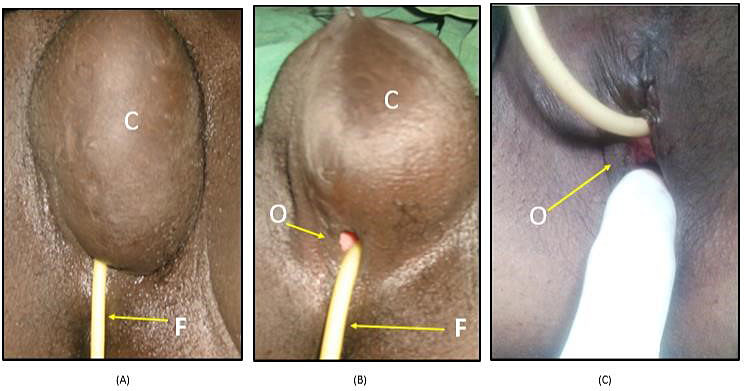
FGM can have short- and long-term consequences, depending on the type and severity of cutting, the health condition of the girl, the condition of the environment and the tools used for the procedure. Several short-term consequences include extreme pain, since this procedure is often conducted without anesthetic, difficulty in passing urine, hemorrhage, infection, fever, shock and damage to the genital organs. Dysmenorrhea and hematocolpos (accumulation of menstrual blood in the vagina) can be the result of narrowing of the vaginal orifice. Furthermore, infection and incomplete healing of the wound post-procedure may result in formation of abscesses, keloid scars and cysts on the vulva (Figure 5), which can be extremely painful and prevent sexual intercourse.3 Unfortunately, these complications may persist into adulthood and continue to affect women throughout their lives.5
5
(A) Vulval inclusion cyst following FGM. (B) A small opening (O) through which a Foley catheter (F) was inserted is visible before surgery. (C) Appearance following surgical treatment.
FGM may adversely affect sexual health and sexual function through alteration or removal of genital structures involved in sexual response, as well as through pain, scarring and psychological effects.6 A meta-analysis by Berg and Denison showed that women subjected to FGM were more likely to report dyspareunia (relative risk (RR), 1.52, 95% CI, 1.15−2.0), no sexual desire (RR, 2.15, 95% CI, 1.37−3.36) and less sexual satisfaction (standardized mean difference, −0.34, 95% CI, −0.56 to −0.13).7 Studies have assessed sexual function using the female sexual function index (FSFI), a validated 19-item questionnaire covering six domains: desire, arousal, lubrication, orgasm, satisfaction and pain. In a case–control study of 130 sexually active women who had undergone FGM and 130 women who had not, participants completed the Arabic version of the FSFI and underwent clinical examination. Women who had undergone FGM had significantly lower overall FSFI scores and lower scores for arousal, lubrication, orgasm and satisfaction, but there were no significant differences in desire or pain scores.8 These findings are consistent with those of a cross-sectional study by Rouzi et al.9 In this study, 107 women underwent clinical examination and completed the Arabic FSFI; 39% had FGM Type I, 25% Type II and 36% Type III. Overall, 92.5% of the women scored below the FSFI cut-off for sexual dysfunction. More extensive FGM was significantly associated with greater sexual dysfunction across all FSFI domains and overall.9
FGM can have significant psychological consequences. The procedure may be experienced as traumatic because of the pain, shock and physical force involved.3 In a small pilot study by Behrendt and Moritz, 30.4% of women who had undergone FGM met criteria for post-traumatic stress disorder (PTSD), and PTSD was associated with memory problems. The authors also reported high levels of fear, helplessness, horror and severe pain associated with the procedure.10
More broadly, studies have reported an increased prevalence of PTSD, anxiety and depression among women and girls who have undergone FGM.3
FGM IN PREGNANCY AND CHILDBIRTH
FGM is associated with an increased risk of several obstetric complications, and the risk generally increases with the extent of FGM.3,11 Women with Type III FGM may have particular concerns about childbirth because of the narrowed vaginal opening. In interviews with women who had previously given birth, some recalled being concerned about whether the vaginal opening was large enough for childbirth, and some reported attempts to limit fetal growth to facilitate delivery.12
FGM is also associated with adverse neonatal outcomes. An observational study reported an increased risk of perinatal death among women with Type II FGM and an increased need for neonatal resuscitation among women with FGM.13
In a 2006 WHO collaborative prospective study of 28,393 women delivering at 28 obstetric centers in six African countries, women who had undergone FGM had increased risks of cesarean section, postpartum hemorrhage, extended maternal hospital stay, infant resuscitation, and stillbirth or early neonatal death compared with women without FGM. Risks generally increased with the extent of FGM. The authors estimated that FGM was associated with an additional 1–2 perinatal deaths per 100 deliveries.14 In an observational study of 85 women with FGM Types 1 and 2 and 95 women without FGM in Burkina Faso, women with FGM had a longer expulsion phase and higher rates of episiotomy, cesarean section, neonatal resuscitation and stillbirth than women without FGM.15
Women with Type III FGM had a 70% higher risk of postpartum hemorrhage (≥500 mL) than women without FGM. In the WHO collaborative study, episiotomy was performed in 88% of primiparous women with Type III FGM compared with 41% of primiparous women without FGM; among multiparous women, the corresponding proportions were 61% and 14%.14 A secondary analysis of 6187 women with Type III FGM examined the association between episiotomy and obstetric outcomes and found that episiotomy was associated with a lower risk of obstetric anal sphincter injury and postpartum hemorrhage.16 A 2024 systematic review and meta-analysis similarly found that Type III FGM was associated with increased risks of postpartum hemorrhage, episiotomy and perineal tears.17
Obstetric fistula is an abnormal connection between the vagina and the rectum or urinary tract that can result in continuous leakage of urine or feces. Severe forms of FGM, particularly Type III, may contribute to obstructed or prolonged labor and may therefore increase the risk of obstetric fistula, particularly where access to timely obstetric care is limited.18 Fistula can have profound physical, psychological and social consequences.19
OPERATIVE CARE AND MANAGEMENT
Reconstructive surgery for FGM aims to address individual anatomical and clinical problems, including scarring, cysts, pain and other complications. The approach depends on the residual genital anatomy and the surgeon's experience and expertise. Where appropriate, surgery may aim to restore aspects of the anatomy and improve sexual function, comfort and body image.
Although FGM can have lifelong consequences, access to appropriate treatment and surgical care remains limited in many settings.
Deinfibulation
Deinfibulation is a surgical procedure in which scar tissue resulting from infibulation is divided to widen the vaginal opening. It is primarily used for Type III FGM and may be indicated when the vaginal opening is insufficient to:
- allow normal urination;
- permit comfortable sexual intercourse;
- allow vaginal examination or cervical screening;
- facilitate vaginal surgery; or
- facilitate safe vaginal birth.
Deinfibulation should be performed with appropriate anesthesia and analgesia. The procedure involves opening the scar tissue sealing the vaginal introitus in women with Type III FGM, usually by making a midline incision, and suturing the cut edges to prevent re-adhesion. The aim is to restore access to the urethral meatus and vaginal opening.
For women with Type III FGM who require deinfibulation to facilitate vaginal birth, either antepartum or intrapartum deinfibulation may be considered, depending on the woman's preference and the clinical context.3 Women may also undergo deinfibulation before pregnancy or for other clinical indications. If deinfibulation is performed during labor, the timing should be determined by the clinical circumstances and the extent of infibulation.3
Deinfibulation may improve some aspects of sexual function. In a study of 18 women who underwent deinfibulation, FSFI scores improved in the domains of desire, arousal, satisfaction and pain at 6 months, whereas lubrication and orgasm did not change significantly.20 In another study of women with Type III FGM, 94% of the 32 women reached for follow-up said they would highly recommend deinfibulation, and all patients and their husbands who were followed were satisfied with the results.21
Reinfibulation
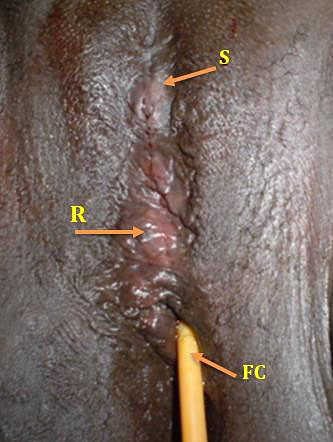
Reinfibulation is the re-suturing of the incised tissue after delivery or gynecological procedures (Figure 6), which is still practiced in communities in which FGM is accepted as part of the culture.
6
Reinfibulated vulva with a Foley catheter (FC) in situ. R, reinfibulated tissue; S, old FGM scar.
Reconstructive surgery
Reconstructive surgery may be performed alongside other procedures to manage complications of FGM, such as vulval cysts or other masses. In one reported case, a young woman with Type III FGM and a large vulval mass underwent excision of the mass together with reconstruction of the affected genital tissue.22 The mass was successfully excised and the external genital anatomy reconstructed.
In a Sudanese series of 660 women who underwent reconstructive surgery for FGM, 86% reported being very satisfied with the procedure; 80% were satisfied with the appearance of the vulva and disappearance of vaginal discharge, and 98% reported regaining or initiating sexual activity.23
A reconstructive-surgery program for women with FGM was established in Sudan in the early 2000s. The program provided surgical treatment alongside counseling and psychological support and involved training healthcare professionals in the management of FGM and its complications. Reconstructive procedures included excision of inclusion cysts and reconstruction of the vulval tissues using the remaining genital tissue where appropriate. The initiative study was extended to more than 8000 FGM patients for reconstructive surgery (pers. comm.). Where appropriate, reconstructive procedures may use the remaining vulval tissues to restore the external genital anatomy. Clitoral reconstruction may also be performed by exposing the remaining clitoral tissue.
Multidisciplinary care
Management of women with FGM and its complications may require a multidisciplinary approach, incorporating appropriate psychological support and counseling alongside specialist surgical care. Healthcare professionals involved in reconstructive procedures should have appropriate training and experience in the surgical and psychosocial aspects of FGM.
The multidisciplinary care package may include:
- Clinical assessment of the vulva, including the type and extent of FGM, associated complications and any relevant comorbidities.
- Psychological assessment and counseling, including assessment of post-traumatic stress, anxiety, shame, body image and sexual concerns, according to the individual woman's needs.
- Assessment and treatment of infections, where present.
- Assessment, treatment and appropriate follow-up for blood-borne infections, including HIV and viral hepatitis.
- Counseling on the expected anatomical and functional outcomes of surgery, including possible changes in genital appearance and sexual function, and support in adjusting to these changes.
- Education about FGM, including information on its health consequences, prevention and available support and services.
- Information and counseling on reproductive and sexual health, including contraception, antenatal care, safe sex, post-abortion care and prevention of sexually transmitted infections, as appropriate to the woman's needs.
Clitoral reconstruction
Clitoral reconstruction may be considered for women with FGM who experience clitoral or vulval pain, sexual difficulties or concerns about genital appearance. It is not a treatment routinely required after Type I FGM, and it is distinct from deinfibulation, which is primarily used to treat the consequences of infibulation.
Clitoral reconstruction involves exposing the remaining clitoral tissue by removing scar tissue surrounding the buried clitoral structures and repositioning the remaining tissue. The procedure has been associated with improvements in pain, sexual function and body image in some studies, although the evidence remains limited and heterogeneous.24,25
Women with Type II or Type III FGM may also request clitoral reconstruction, including for chronic pain, sexual concerns or dissatisfaction with genital appearance.25 Although reported outcomes are encouraging, the evidence base remains limited, and further research is needed to establish the effectiveness and safety of the procedure and to inform clinical guidance.
CONCLUSION
The management of women with FGM should be individualized according to their anatomical, clinical, psychological and reproductive health needs. Surgical procedures such as deinfibulation and, in selected cases, reconstructive surgery may address specific complications, but the evidence supporting some reconstructive techniques remains limited. Multidisciplinary care, including appropriate psychological and sexual health support, is important.
Prevention of FGM remains essential. Education, community engagement and efforts to address the social and cultural factors that perpetuate the practice are needed alongside accessible, respectful care for women and girls who have undergone FGM.
CONFLICTS OF INTEREST
The author(s) of this chapter declare that they have no interests that conflict with the contents of the chapter.
Feedback
Publishers’ note: We are constantly trying to update and enhance chapters in this Series. So if you have any constructive comments about this chapter please provide them to us by selecting the "Your Feedback" link in the left-hand column.
REFERENCES
Klein E, Helzner E, Shayowitz M, Kohlhoff S, Smith-Norowitz TA. Female Genital Mutilation: Health Consequences and Complications-A Short Literature Review. Obstet Gynecol Int. 2018 Jul 10;2018:7365715. doi: 10.1155/2018/7365715. PMID: 30116269; PMCID: PMC6079349. | |
UNICEF. Female Genital Mutilation: A Global Concern — 2024 Update [Internet]. New York: United Nations Children's Fund; 2024 Mar 8. Available from: https://data.unicef.org/resources/female-genital-mutilation-a-global-concern-2024/ | |
World Health Organization. WHO guideline on the prevention of female genital mutilation and clinical management of complications [Internet]. Geneva: World Health Organization; 2025. | |
Female Genital Mutilation and its Management. RCOG Green-top Guideline No. 53, 2015 | |
Reyners M. Health consequences of female genital mutilation. Reviews in Gynaecological Practice 2004;4(4):242–51. doi: 10.1016/j.rigp.2004.06.001. | |
Buggio L, Facchin F, Chiappa L, et al. Psychosexual Consequences of Female Genital Mutilation and the Impact of Reconstructive Surgery: A Narrative Review. Health Equity 2019;3(1):36–46. Published 2019 Feb 20. doi:10.1089/heq.2018.0036. | |
Berg RC, Denison E. Does Female Genital Mutilation/Cutting (FGM/C) Affect Women’s Sexual Functioning? A Systematic Review of the Sexual Consequences of FGM/C. Sex Res Soc Policy 2012;9:41–56. | |
Alsibiani SA, Rouzi AA. Sexual function in women with female genital mutilation. Fertil Steril 2010;93:722–4. | |
Rouzi AA, Berg RC, Sahly N, et al. Effects of female genital mutilation/cutting on the sexual function of Sudanese women: a crosssectional study. Am J Obstet Gynecol 2017;217:62.e1-e62.e6. | |
Behrendt A, Moritz S. Posttraumatic stress disorder and memory problems after female genital mutilation. Am J Psychiatry 2005;162(5):1000–2. doi: 10.1176/appi.ajp.162.5.1000. PMID: 15863806. | |
Pallitto C, Ruiz-Vallejo F, Mochache V, Stein K, Vogel JP, Petzold M. Exploring the health complications of female genital mutilation through a systematic review and meta-analysis. BMC Public Health. 2025;25:1387. doi:10.1186/s12889-025-21584-z | |
WHO. A Systematic Review of the Health Complications of Female Genital Mutilation Including Sequelae in Childbirth. World Health Organization, Geneva, Switzerland, 2000. | |
Armitage A, Bittaye M, Agbala S, et al. G261 Neonatal outcomes of female genital mutilation/cutting (fgm/c) in the gambia: results from a multicentre prospective observational study. Archives of Disease in Childhood 2018;103:A107. | |
WHO study group on female genital mutilation and obstetric outcome. Female genital mutilation and obstetric outcome: WHO collaborative prospective study in six African countries. Lancet 2006;367:1835–41. doi:10.1016/S0140-6736(06)68805-3. | |
Frega A, Puzio G, Maniglio P, et al. Obstetric and neonatal outcomes of women with FGM I and II in San Camillo Hospital, Burkina Faso. Arch Gynecol Obstet 2013;288(3):513–9. doi: 10.1007/s00404-013-2779-y. Epub 2013 Mar 8. PMID: 23471548. | |
Rodriguez MI, Seuc A, Say L, et al. Episiotomy and obstetric outcomes among women living with type 3 female genital mutilation: a secondary analyisis. Reprod Health 2016;13:131. https://doi.org/10.1186/s12978-016-0242-9. | |
Bonavina G, Spinillo SL, Sotiriadis A, Bulfoni A, Kaltoud R, Salvatore S, Candiani M, Ivo Cavoretto P. Effect of type III female genital mutilation on obstetric outcomes: A systematic review and meta-analysis. Heliyon. 2024 Apr 8;10(8):e29336. doi: 10.1016/j.heliyon.2024.e29336. PMID: 38628703; PMCID: PMC11019231. | |
Mathieu M-G, Véronique F, Sékou S, et al. Prevalence of symptoms of vaginal fistula in 19 subSaharan Africa countries: a meta-analysis of national household survey data. The Lancet Global Health 2015;3(5):e271e278. ISSN 2214-109. | |
Birge O, Ozbey E, Güzel, Ö, et al. The relationship between urogenital fistula and female genital mutilation. Journal of Turgut Ozal Medical Center 2016;23:293–6. | |
Krause E, Brandner S, Mueller MD, et al. Out of Eastern Africa: defibulation and sexual function in woman with female genital mutilation. J Sex Med 2011;8(5):1420–5. doi: 10.1111/j.17436109.2011.02225.x. Epub 2011 Mar 2. PMID: 21366880. | |
Nour NM, Michels KB, Bryant AE. Defibulation to treat female genital cutting: effect on symptoms and sexual function. Obstet Gynecol. 2006;108(1):55–60. doi:10.1097/01.AOG.0000224613.72892.77 | |
Fazari AB, Berg RC, Mohammed WA, Gailii EB, Elmusharaf K. Reconstructive surgery for female genital mutilation starts sexual functioning in Sudanese woman: a case report. J Sex Med. 2013 Nov;10(11):2861-5. doi: 10.1111/jsm.12286. Epub 2013 Jul 30. PMID: 23899044. | |
Fazari A. Surgical outcomes and clients’ satisfaction with reconstructive surgery for female genital mutilation: a critical initiative against FGM/C. Presented at: International Conference on Female Genital Mutilation/Cutting; Nairobi, Kenya. | |
Thabet SM, Thabet AS. Defective sexuality and female circumcision: the cause and the possible management. J Obstet Gynaecol Res 2003;29(1):12–9. doi: 10.1046/j.1341-8076.2003.00065.x. PMID: 12696622. | |
Abdulcadir J, Rodriguez MI, Petignat P, et al. Clitoral reconstruction after female genital mutilation/cutting: case studies. J Sex Med 2015;12(1):274–81. doi:10.1111/jsm.12737. |
Online Study Assessment Option
All readers who are qualified doctors or allied medical professionals can automatically receive 2 Continuing Professional Development points plus a Study Completion Certificate from GLOWM for successfully answering four multiple-choice questions (randomly selected) based on the study of this chapter. Medical students can receive the Study Completion Certificate only.
(To find out more about the Continuing Professional Development awards program CLICK HERE)
